Best Swim Training Equipment for Triathletes in 2026
Six swim training tools that actually fix adult-onset swimmer problems: tempo trainer, snorkel, pull buoy, paddles, short fins, and an open-water safety buoy.
FullKitTri is reader-supported. We may earn a commission from qualifying purchases made through links on this page.
Most triathletes who came to the sport as adults have the same swim problem: they are fit enough to hold a decent effort, but their stroke falls apart the moment they stop thinking about it. You can't fix that with more yards alone. You fix it with tools that remove one variable at a time so your brain can learn a new movement pattern.
The trap is buying a mesh bag full of gear and using none of it well. Every item below solves a specific, identifiable problem. If you don't have that problem, skip that item. A tempo trainer and a snorkel will do more for a 2:05/100m swimmer than a full set of paddles, fins, bands, parachutes, and ankle buoys ever will.
One honest caveat: gear is a distant second to coaching. If you can get video feedback or a Masters lane with a coach who actually watches you, do that first. These tools make good coaching stick faster — they don't replace it. And none of them matter on race day, where goggles that fit and don't fog and open-water skills decide your swim split.
How we picked
- One tool per job. We picked the single best option for pacing, technique feedback, body position, catch, ankle mobility, and open-water safety — not six variations on the same thing.
- Fixes an adult-onset problem. Every pick addresses a failure mode common in triathletes who learned to swim after age 25: sinking legs, dropped elbow, breathing-driven stroke collapse, no pacing sense.
- Durability in chlorine. Silicone and EVA foam over cheap thermoplastic; established swim brands (FINIS, Speedo, New Wave) over unbranded listings that vanish in six months.
- Pool-bag practical. It has to fit in a mesh bag, survive being dropped on deck, and not require a manual to operate on the wall between reps.
- Research-based. These are judgments from spec comparison, long-running community consensus on triathlon and Masters forums, and what actually shows up on pool decks — not lab testing.
Quick picks
| Product | Best for | Price | |
|---|---|---|---|
| FINIS Tempo Trainer Pro — Best for pacing and stroke rate | Swimmers who go out too hard, fade, or have no idea what a repeatable pace feels like without a clock. | $66.00 | View |
| FINIS Original Swimmer's Snorkel — Best for technique and head position | Anyone whose stroke falls apart every time they turn to breathe. | $45.00 | View |
| New Wave Swim Buoy 15L — Best open-water safety buoy | Anyone who swims in a lake, bay, or river where boats exist and lifeguards don't. | $34.95 | View |
| Speedo Swim Training Pull Buoy — Best basic pull buoy | Swimmers who need to feel a correct body position before they can build it themselves. | $14.36 | View |
| FINIS Agility Floating Paddles — Best technique paddles | Swimmers with a dropped elbow who need honest, instant feedback on their catch. | $26.00 | View |
| FINIS Zoomers Gold — Best short training fins | Runners and cyclists with stiff ankles whose kick actively creates drag. | $44.00 | View |
| FINIS Glide Center-Mount Swim Snorkel — Lower-drag snorkel alternative | Faster swimmers who want a snorkel that doesn't feel like a parachute at race pace. | $40.00 | View |
The picks, in detail
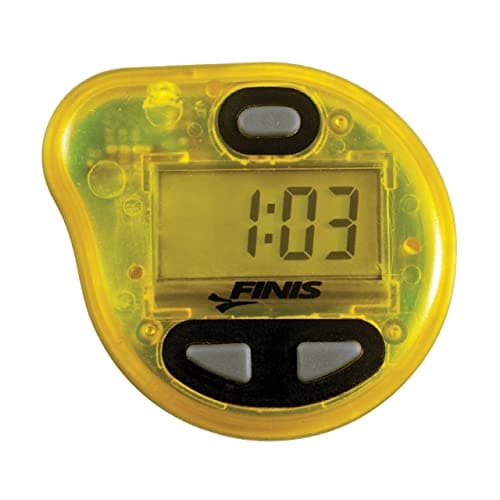 #1
#1FINIS Tempo Trainer Pro — Best for pacing and stroke rate
Best for: Swimmers who go out too hard, fade, or have no idea what a repeatable pace feels like without a clock.
- Beeps in your cap at a set interval so pace becomes a feeling, not a guess
- Three modes: stroke rate (beeps per stroke), pace per length, and simple metronome
- Directly transfers to open water, where there is no pace clock and no wall
- Excellent for raising cadence — most adult-onset swimmers over-glide and stall
- Tiny, tucks under a swim cap next to the ear, and you stop noticing it after a lap
- Button-sequence programming is genuinely annoying; you will re-learn it every few weeks
- Replaceable coin battery requires careful reseating of the o-ring or it floods
- Expensive for what is fundamentally a waterproof beeper
- Easy to lose on deck or in the bottom of a mesh bag
If you buy one thing on this list, buy this. The most common triathlon swim mistake is not bad technique — it's blowing the first 200m and spending the rest of the leg recovering, and a tempo trainer is the only tool that teaches you what goal pace actually feels like stroke by stroke. Set it to your target stroke rate for a few sets, then switch to pace mode and negative-split a 400; the feedback loop is immediate and you'll carry it into open water where you're swimming blind.
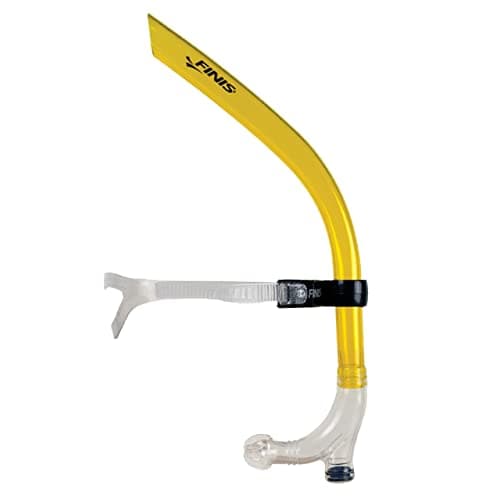 #2
#2FINIS Original Swimmer's Snorkel — Best for technique and head position
Best for: Anyone whose stroke falls apart every time they turn to breathe.
- Removes breathing from the equation so you can focus on one thing: catch, rotation, or head position
- Center-mount design keeps head and spine neutral instead of pulling to one side
- Purge valve clears water without stopping, so drills don't get interrupted
- Pairs perfectly with paddles or a pull buoy for isolated technique sets
- The de facto standard on Masters decks — parts and replacement mouthpieces are easy to find
- Bulky tube compared to the slimmer FINIS Glide; noticeably more drag at speed
- Flip turns take real practice and you'll swallow water learning
- Head bracket can press uncomfortably on the forehead until you dial the strap
- Premium price for a plastic tube, and the mouthpiece eventually needs replacing
Breathing is the single biggest stroke-wrecker for adult-onset swimmers: you lift the head, the hips drop, the legs sink, and every rep reinforces the error. A snorkel removes that variable entirely so you can actually feel what a long, balanced body line is like, then gradually reintroduce breathing without losing it. Use it for 400-800 of drill and easy swimming per session, not for everything — you still need to practice breathing under fatigue.
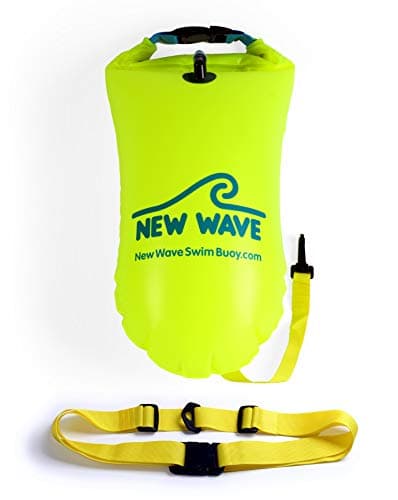 #3
#3New Wave Swim Buoy 15L — Best open-water safety buoy
Best for: Anyone who swims in a lake, bay, or river where boats exist and lifeguards don't.
- Bright, high-visibility float that makes you visible to boat traffic and paddlers
- 15L dry compartment holds keys, phone, and a thin shirt for post-swim
- Something to hold onto if you cramp, panic, or need to reset your breathing
- Trails behind on a waist belt; after five minutes you forget it's there
- Deflates and rolls into a jersey pocket or the top of a transition bag
- Adds a small amount of drag and an occasional tug at high stroke rates
- Not a personal flotation device and won't keep an unconscious swimmer face-up
- The dry compartment only stays dry if you roll and clip the closure properly
- Valve can slowly leak air on long swims if it isn't seated firmly
This is the cheapest life insurance in triathlon and the one piece of gear on this list that has nothing to do with going faster. Most drownings in open water involve swimmers who were invisible to boats or who had no way to rest; a buoy fixes both problems for the price of a couple of gels. Pair it with our open-water swim tips and never swim alone in water you can't stand up in without one.
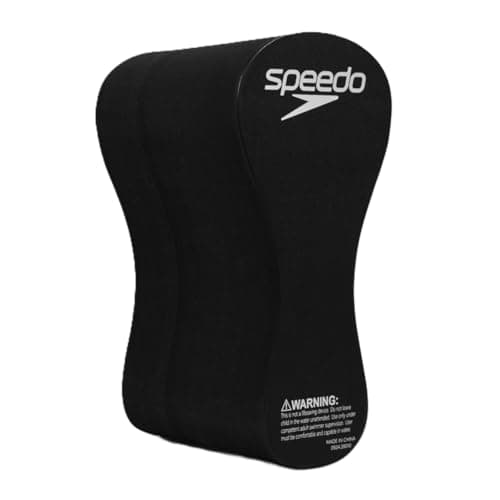 #4
#4Speedo Swim Training Pull Buoy — Best basic pull buoy
Best for: Swimmers who need to feel a correct body position before they can build it themselves.
- Classic figure-eight EVA foam shape that stays put between the thighs
- Lifts the hips so you can swim in good alignment while your kick catches up
- Lets you accumulate upper-body volume without frying your legs before a brick
- Cheap, indestructible, and available in every pool shop on earth
- Easy to over-rely on — buoys mask sinking legs rather than fixing them
- Bare foam can chafe the inner thighs on long pull sets
- One size only; very lean or very large swimmers may find it slips
- Does nothing for ankle flexibility or kick timing
A pull buoy is the fastest way to show a sinking-legs swimmer what a horizontal body actually feels like, and that reference point is worth a lot. The risk is that it becomes a crutch — if your pull sets are 20 seconds per 100 faster than your swim sets, your kick and body position are the real problem. Cap it at roughly a quarter of your session and use the rest of the yardage to reproduce that feeling unaided.
 #5
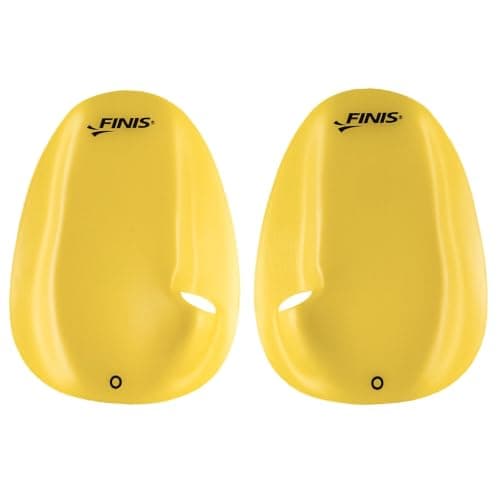
#5FINIS Agility Floating Paddles — Best technique paddles
Best for: Swimmers with a dropped elbow who need honest, instant feedback on their catch.
- Strapless design: the paddle only stays on your hand if you're pressing water backward correctly
- Floating, anatomically curved shape encourages an early vertical forearm
- Low injury risk compared with big flat power paddles
- Teaches feel for the water instead of just adding load
- They will fall off constantly at first, which is frustrating but is literally the point
- No straps means you can't use them for heavy strength or sprint work
- Sizing matters and there's no adjustment — get the chart right before ordering
- Overkill if your basic body position isn't sorted yet
Big flat paddles with two straps mostly teach you to muscle water with a bad arm position and, for a lot of age-groupers, teach you shoulder impingement too. Agility paddles flip the logic: press correctly and they stay glued to your palm, slip your elbow and they slide off immediately. Use them for short technique sets of 50s and 100s with the snorkel, not as a strength tool.
 #6
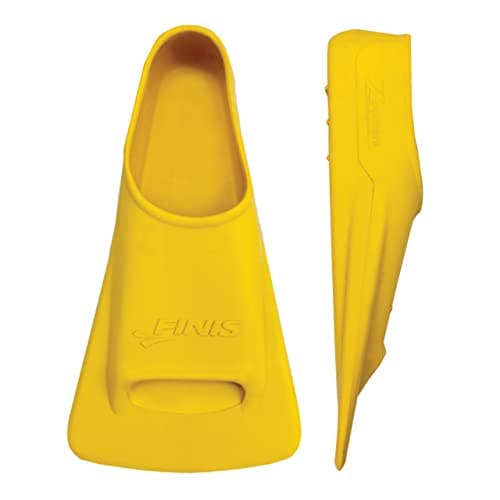
#6FINIS Zoomers Gold — Best short training fins
Best for: Runners and cyclists with stiff ankles whose kick actively creates drag.
- Short, stiff blade builds kick tempo instead of letting you cruise at unrealistic speeds
- Stretches notoriously tight ankles common in runners and cyclists
- Makes drill work possible at a speed where you can actually feel body rotation
- Natural rubber foot pocket is comfortable once broken in
- Short blade means less shoulder overload than long fins when combined with paddles
- Natural rubber can cause blisters during break-in and irritates latex-sensitive skin
- Letter-based sizing (A-E) is confusing and doesn't map cleanly to shoe size
- Stiff blade is hard work for weak kickers at first
- Easy to hide bad body position behind fin propulsion if you overuse them
Triathletes with locked-up ankles from running and cycling don't just have a weak kick — they have a kick that drags, like dropping an anchor every stroke cycle. Short fins add just enough propulsion to let you work on tempo and rotation while passively stretching the ankle joint. Keep sets short, wear thin socks during the break-in period, and treat them as a mobility tool rather than a speed tool.
 #7
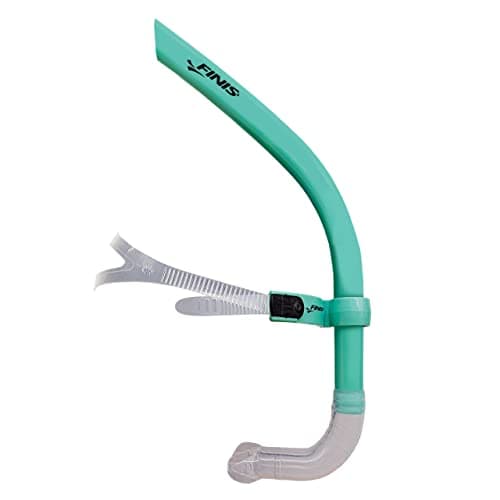
#7FINIS Glide Center-Mount Swim Snorkel — Lower-drag snorkel alternative
Best for: Faster swimmers who want a snorkel that doesn't feel like a parachute at race pace.
- Slimmer, more hydrodynamic tube than the Original — noticeably less drag at speed
- Same center-mount body alignment benefit
- Adjustable head bracket fits a wide range of head sizes
- Fine for tempo and threshold sets, not just slow drill work
- Narrower tube restricts airflow more; hard-breathing swimmers may feel starved
- Costs about the same as the Original with less airflow headroom
- Still awkward on flip turns
- Redundant if you already own any decent center-mount snorkel
Listed here as the alternative rather than a separate job: if you're already swimming sub-1:30/100m and the Original feels like dragging a mast, the Glide is the version to buy. If you're a developing swimmer doing slow drill work and gasping is a real possibility, take the Original's bigger tube instead.
What to look for
- Buy for a diagnosed problem, not a shopping list. Sinking legs means pull buoy and snorkel. No pacing sense means tempo trainer. Dropped elbow means technique paddles. Stiff ankles mean short fins. Buying all five at once guarantees you'll use none of them properly.
- Silicone and EVA over hard plastic. Mouthpieces, straps, and foot pockets are what fail first. Established swim brands sell replacement parts; unbranded listings don't.
- Small paddles beat big paddles. Surface area is not the goal — feel is. Oversized flat paddles are the most common cause of age-group swim shoulder injuries.
- Short-blade fins only. Long snorkeling fins let you swim at a speed your stroke can't support and teach nothing useful.
- A safety buoy is not optional in open water. Visibility to boats is the entire argument. Get a bright one and clip it on every single time.
- Rinse everything in fresh water. Chlorine destroys rubber and silicone faster than use does. Thirty seconds under the tap doubles the life of your bag.
Common questions
How much of a session should use gear?
As a rough guideline, keep at least two-thirds of your yardage unaided. Tools create a feeling; the rest of the session is where you learn to reproduce that feeling with nothing on your hands or between your legs. Swimmers who do 3,000-yard paddle-and-buoy sessions get strong and stay slow.
Do I need paddles and fins at all as a triathlete?
Not necessarily. If you're a 1:50/100m swimmer whose legs sink, a snorkel, pull buoy, and tempo trainer will cover 90% of the gains available to you. Paddles and fins are refinement tools — add them once you can hold a straight body line and a consistent stroke rate for 400 continuous meters.
Does pool gear help with open-water racing?
Indirectly, except for the tempo trainer, which helps directly. Open water punishes swimmers who can't self-regulate pace or hold form without lane lines. Train the pacing and body position in the pool, then spend real time in the lake practicing sighting, wetsuit swimming, and starts — see our open-water swim tips and the wetsuit guide before your first mass start.
What about a kickboard or a snorkel with a stopwatch?
A kickboard is cheap and fine, but most triathletes get more from vertical kicking and fins-plus-snorkel kick sets on the side. A dedicated swim stopwatch is redundant if you already own a multisport watch.
Bottom line
If you buy one thing: the FINIS Tempo Trainer Pro. It's the tool with the most direct transfer to a faster race swim.
If you buy two: add the FINIS Original Swimmer's Snorkel, because breathing is what breaks your stroke.
If you swim outdoors at all: the New Wave Swim Buoy 15L is non-negotiable, regardless of how fast you are.
Add the Speedo pull buoy when you need a reference for good body position, the FINIS Agility paddles when your catch is the limiter, and the FINIS Zoomers Gold if your ankles are as stiff as most runners'. Also worth a look if you can find them elsewhere: a basic silicone ankle band for sinking-leg diagnosis, and a cheap two-pack of latex caps to hold your tempo trainer in place.
When the pool work is done, spend your remaining budget on goggles that actually seal — no training aid saves a swim leg you spend treading water emptying your left lens.
Written by
FullKitTri Editors
The FullKitTri editorial team reviews triathlon gear across every discipline and budget. Our recommendations are based on hands-on racing experience, independent research, and hundreds of hours comparing products.
- Combined 50+ triathlons completed
- Sprint through Ironman distance experience
More in Swim Gear
Orca Apex Flex vs. Athlex Float: Which Orca Wetsuit Should You Buy?
Orca Apex Flex vs Athlex Float: we break down flexibility, buoyancy, price and sizing so you know which Orca triathlon wetsuit suits your swim.
Read guideOpen-Water Swim Tips for First-Timers: Conquer the Chaos
Open-water swimming guide for first-time triathletes — how to handle panic, sight efficiently, draft legally, and survive the washing machine of a mass swim start.
Read guideBest Open Water Swim Goggles for Triathlon in 2026
The best open water goggles for triathlon — wide peripheral vision, anti-fog coatings, and tinted lenses compared across sprint, 70.3, and Ironman distances.
Read guideBest Triathlon Wetsuits Under $300 in 2026
The best budget triathlon wetsuits under $300 — how to get 80% of a premium suit's performance for a third of the price, and which sub-$300 wetsuits actually deliver.
Read guide#1 pick
FINIS Tempo Trainer Pro — Best for pacing and stroke rate