Best Triathlon Hydration Systems in 2026: BTA, Frame, Rear-Mount, and Handheld
BTA, frame, rear-mount, and handheld hydration compared for sprint through Ironman, with real notes on refilling, bottle ejection, and how much to carry.
FullKitTri is reader-supported. We may earn a commission from qualifying purchases made through links on this page.
Hydration is the one piece of bike setup where aerodynamics, practicality, and not-throwing-a-bottle-at-the-rider-behind-you all collide. Get it right and you drink without sitting up, refill at aid stations without stopping, and finish the bike leg ready to run. Get it wrong and you spend 56 miles reaching down for a cage you can't see, or you launch a full bottle over a railroad crossing and ride the last hour dry.
There are really only four places to put fluid on a tri bike: between the arms (BTA), on the frame, behind the saddle, or in your hand on the run. Each solves a different problem. BTA is the aero and ergonomic winner and should be your first bottle. A frame bottle is your backup and your refill source. Rear mounts exist to carry spares on long course — they are not where your primary drinking bottle should live. And a handheld is a run-leg tool for hot races with thin aid station coverage.
The other thing nobody tells beginners: your hydration system is a fueling system. Most of us carry concentrated drink mix up front and plain water in the frame or rear bottle so we can dilute, rinse, and wash down gels. Figure out the fuel plan first — our triathlon nutrition guide and electrolyte tablets guide cover that side — then buy the hardware that delivers it.
How we picked
- Mount position coverage. We picked at least one strong option for each spot on the bike, plus one handheld, rather than six near-identical BTA cages.
- Refillability on course. Systems with a wide top opening or a dedicated refill port let you dump an aid-station bottle in and keep rolling. Sealed bottles you have to swap are slower and messier.
- Retention on rough roads. Ejection is the classic failure. We favored clamps and cages with a reputation for holding through chipseal, cattle grids, and expansion joints, and we flag the setups that need a strap or zip tie.
- Fit reality. Aerobar extension diameter and shape, front-end clutter, and whether a mount takes a standard bottle or a proprietary one all matter more than claimed watt savings.
- Brand track record over listing hype. Profile Design, XLAB, Nathan, Amphipod, and HydraPak dominate transition areas for a reason. We skipped no-name saddle adapters and generic aero bottle sets, and we ignored refill kits, spare bottles, and bare cages.
Quick picks
| Product | Best for | Price | |
|---|---|---|---|
| Profile Design Aero HC System — Best overall between-the-arms setup | Age-groupers who want one proven BTA bottle they can top up at every aid station without slowing down. | $74.96 | View |
| XLAB Torpedo Versa 500 — Best BTA system that takes a standard bottle | Riders who want a front bottle they can swap at an aid station rather than refill, with fine-grained height and angle adjustment. | $180.95 | View |
| Profile Design HSF/Aeroflow 700 — Best aero frame bottle system | Long-course racers who want a fast-looking down tube bottle that still works as a real, drinkable backup. | $138.07 | View |
| Profile Design RZ3 Aero Water Bottle System — Best budget frame bottle | Sprint and Olympic athletes who just want a tidy, secure frame bottle without spending long-course money. | $44.95 | View |
| XLAB Mini Wing 105 — Best rear mount for carrying spares | Ironman and hilly 70.3 racers who need to carry two extra bottles or a spares kit without cluttering the front of the bike. | $69.95 | View |
| Nathan SpeedDraw Plus Insulated — Best handheld for the run leg | Hot-weather racers and anyone running long course where aid stations are farther apart than their stomach can handle. | $34.99 | View |
The picks, in detail
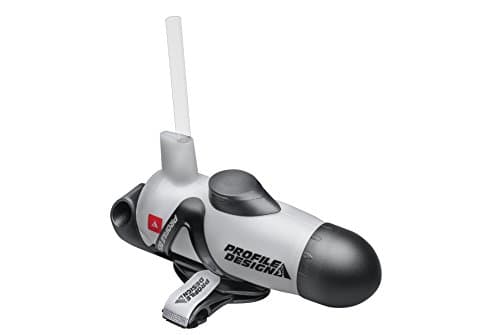 #1
#1Profile Design Aero HC System — Best overall between-the-arms setup
Best for: Age-groupers who want one proven BTA bottle they can top up at every aid station without slowing down.
- Open top fill port makes mid-race refills genuinely one-handed — pour and go
- Straw sits right at your mouth so you drink in aero instead of sitting up
- Mounts to most round aerobar extensions with the included bracket
- Clear bottle lets you see remaining fluid at a glance
- Long-running design with widely available replacement parts
- Sloshing and some splash-out on rough roads unless the cover is seated properly
- Proprietary bottle — you can't grab a standard cage bottle and drop it in
- Bracket fit can be fiddly on oval, flat, or oversized carbon extensions
- Needs regular cleaning; sugary mix in a straw system gets nasty fast
This is the default answer for a reason: it puts fluid in the most aerodynamic and most ergonomic spot on the bike, and the wide fill opening means you can take a water bottle from a volunteer, dump it in, and toss the empty in the litter zone without breaking rhythm. It is not the lightest or the fanciest front system, but it does the job that matters on race day. If your bike has flat or aero-shaped extensions, measure before you buy — clamp compatibility is the most common complaint, not performance.
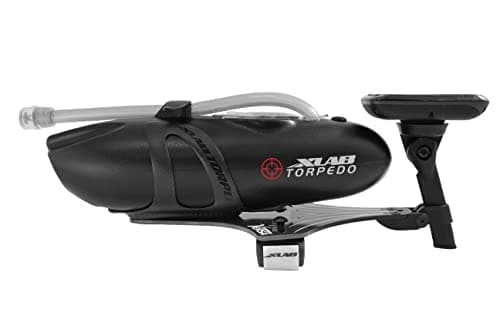 #2
#2XLAB Torpedo Versa 500 — Best BTA system that takes a standard bottle
Best for: Riders who want a front bottle they can swap at an aid station rather than refill, with fine-grained height and angle adjustment.
- Takes a standard round bottle, so aid-station hand-ups drop straight in
- Carbon cage with strong grip force — good reputation for staying put on rough pavement
- Adjustable fore/aft, height, and angle to clear computers and extension shapes
- Works as a sealed bottle setup, which means no splash-out
- Cage can be reused across bikes as your setup evolves
- Costs meaningfully more than a basic BTA bottle-and-bracket kit
- Front-end real estate gets crowded fast if you also run a big bike computer
- Bottle plus straw setup still needs cleaning, and straws are a consumable
- Stock levels are inconsistent, so you may be shopping the variant list
The swap-versus-refill decision drives which BTA system you should buy. If your races hand out bottles you can actually use, a standard-bottle cage like this is faster and cleaner than pouring, and the carbon cage's grip is the main reason people trust it over chipseal. Pair it with a bike computer mount you've already test-fitted, because the cockpit gets busy in a hurry.
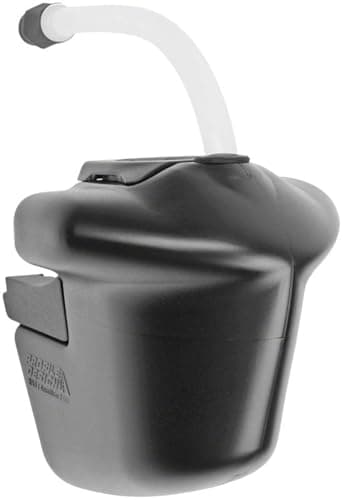 #3
#3Profile Design HSF/Aeroflow 700 — Best aero frame bottle system
Best for: Long-course racers who want a fast-looking down tube bottle that still works as a real, drinkable backup.
- Aero-profiled bottle and cage designed to work with the frame rather than stick out of it
- Magnetic bite valve returns to position instead of flapping around
- Wide top cap makes cleaning and refilling straightforward
- Modular design lets you adapt the setup as your frame and needs change
- Frees the BTA spot for concentrated mix while this carries plain water
- Premium price for a frame bottle — the aero gain is small relative to the cost
- Aero-shaped bottle won't fit every frame or every standard cage cleanly
- More parts than a plain bottle means more things to lose or replace
- Still requires reaching down, which costs you aero position and a few seconds
Your second bottle should live on the frame, not behind the saddle, because it's easier to reach, easier to refill, and far less likely to eject. This one earns its keep by being shaped for the down tube and by having a bite valve that doesn't disappear into the wind. If you're on a tight budget, a plain bottle in a good cage does 90% of this job — buy this when you've already sorted position, helmet, and wheels.
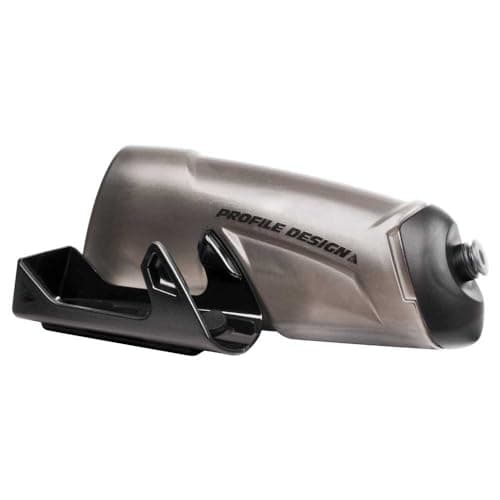 #4
#4Profile Design RZ3 Aero Water Bottle System — Best budget frame bottle
Best for: Sprint and Olympic athletes who just want a tidy, secure frame bottle without spending long-course money.
- Aero-shaped bottle and matched cage for well under the price of premium systems
- Bolts to standard bottle bosses — no adapters, no drama
- Secure fit that holds better than a generic cage and round bottle on rough roads
- Good option for the single-bottle setup that covers most short-course racing
- Proprietary bottle shape limits you to what it came with
- No refill port or straw — you drink the old-fashioned way, out of aero
- Aero benefit is modest and highly frame-dependent
- Not enough capacity on its own for hot 70.3 or Ironman racing
For sprint and Olympic distance, one frame bottle is frequently the entire hydration plan, and this is the sensible version of it: aero-ish, cheap, and it stays in the cage. Racing longer or in heat? Treat this as bottle number two behind a BTA system rather than your primary. It's also the easy first upgrade on a road bike running clip-on aero bars.
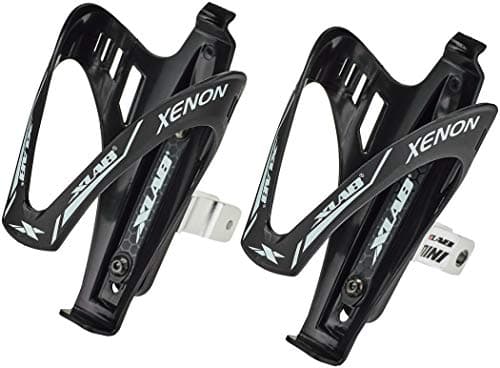 #5
#5XLAB Mini Wing 105 — Best rear mount for carrying spares
Best for: Ironman and hilly 70.3 racers who need to carry two extra bottles or a spares kit without cluttering the front of the bike.
- Carries two bottles behind the saddle for long, sparsely supported courses
- Short 105mm offset keeps weight close to the saddle, reducing bounce and leverage
- Aluminum construction rated for real-world loads, not a plastic adapter
- Doubles as a mounting point for CO2 and tool storage
- Keeps your down tube free for the bottle you actually drink from
- Rear bottles are the most common ejection point on rough roads — many races penalize littering
- You have to sit up and reach behind you, which is slow and unstable at speed
- Saddle rail compatibility varies; carbon rails and some tri saddles are a problem
- Check the listing carefully for whether cages are included
Rear mounts are storage, not drinking. Use one to carry concentrate or spare bottles you'll transfer forward, and never make it your primary source of fluid mid-ride. If you run it, secure the bottles — a tight, high-retention cage or a simple rubber band across the top is standard practice on chipseal courses, and it's the difference between finishing hydrated and getting a littering penalty.
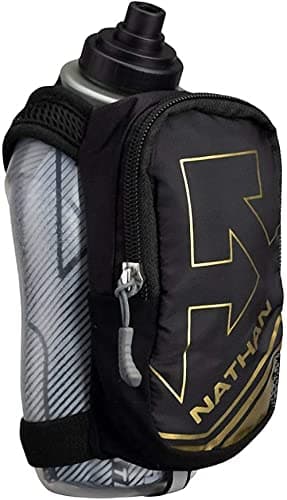 #6
#6Nathan SpeedDraw Plus Insulated — Best handheld for the run leg
Best for: Hot-weather racers and anyone running long course where aid stations are farther apart than their stomach can handle.
- Hand strap means you carry it without gripping, so your forearm doesn't cramp
- Insulated sleeve keeps fluid drinkable longer in real race heat
- Small zip pocket swallows gels, a key, or a salt tab stash
- Easy to grab in T2 and drop at the finish or at a special-needs bag
- Any handheld unbalances your arm carry slightly — you must train with it
- Modest capacity; it bridges aid stations rather than replacing them
- Bite valves can leak or drip if not fully closed after a squeeze
- Unnecessary for sprint and most Olympic races with stations every mile or two
Most triathletes should run empty-handed and drink at aid stations — but if you race hot, run slow enough that stations are 12+ minutes apart, or need a specific drink mix your stomach tolerates, a handheld is worth the small penalty. Practice with it on long runs, because the arm-swing adjustment is real, and decide in advance where you'll ditch it. If you're stashing gels and salt anyway, see the nutrition guide for what actually fits in that pocket.
What to look for
- Refill method. Open-port systems (pour and go) are fastest at aid stations, sealed standard-bottle systems (swap and go) are cleanest. Pick one and rehearse it — do not discover your bracket blocks the bottle swap on race morning.
- Extension compatibility. Round, oval, flat, and integrated carbon extensions all clamp differently. Measure your extensions before buying any BTA mount; this is the single biggest source of returns.
- Retention on rough roads. Bottle ejection almost always happens behind the saddle or in a cheap plastic cage. Choose cages with high grip force, and on known-rough courses add a rubber band or strap. Losing a bottle in a marked litter-free zone can cost you a penalty as well as your fluid.
- Capacity by distance. Rough planning numbers, not gospel: sprint often needs one bottle or none, Olympic one to two, 70.3 two to three plus aid-station top-ups, and Ironman means planning around aid station spacing rather than carrying everything. Most athletes land somewhere around 500–750ml per hour in moderate heat and more when it's brutal.
- Concentrate up front, water in the frame. Carry your calories in the BTA bottle where you drink most often, and keep plain water where it's easy to refill. It lets you dilute, rinse gels down, and cool off without ruining your mix.
- Cleaning access. Straws, bite valves, and narrow bottle necks all grow mold if you leave sugary mix in them. Buy something you can get a brush into, or you'll be replacing it every season.
Common questions
Do I need a BTA bottle for a sprint?
No. For a sprint you can often ride the whole bike leg on a single frame bottle, or skip drinking entirely if it's cool and the race is under an hour. Spend the money on your tri suit or wetsuit fit instead.
Is a rear-mount system worth the ejection risk?
Only for long course, hilly or remote courses, or when you need specific fuel that aid stations don't carry. Use it for spares, not for the bottle you drink from, and secure the bottles mechanically. On smooth, well-supported courses, two bottles up front and on the frame is simpler and faster.
Can I use a hydration pack on the bike?
You can, but almost nobody racing triathlon does. Packs are hot, hard to refill on the move, and cost you more in comfort and cooling than they save in convenience. A BTA bottle plus one frame bottle covers nearly every scenario.
How do I practice refilling?
On a quiet road or your local group ride loop, put a full spare bottle in a jersey pocket or rear cage and transfer it forward at speed, then repeat until you can do it without weaving. Do the same drill for grabbing a bottle from a stationary hand — a friend on a corner works fine. Ten minutes of practice prevents a race-day soaking.
Bottom line
If you buy one thing, buy the Profile Design Aero HC System — it's the cheapest meaningful aero and comfort gain available, and it refills fast. If you'd rather swap bottles than pour and want serious adjustability and cage grip, step up to the XLAB Torpedo Versa 500. Add the Profile Design HSF/Aeroflow 700 as a fast, drinkable second bottle for 70.3 and Ironman, or the Profile Design RZ3 if you're short-course and just want a secure frame bottle without the spend. Carrying real spares on a long or remote course? The XLAB Mini Wing 105 does it without cluttering your cockpit. And for a hot run leg with thin aid station coverage, the Nathan SpeedDraw Plus Insulated is the handheld to train with.
Also worth a look if you can find them outside this lineup: TorHans Aero30 for a tall, high-capacity down tube bottle, Speedfil's hands-free frame systems if you want a straw off the frame rather than the bars, and Bontrager's frame-specific Speed Bottles if you ride a Trek Speed Concept. Whatever you choose, install it a month out and do at least two long rides with it before you pin a number on.
Written by
FullKitTri Editors
The FullKitTri editorial team reviews triathlon gear across every discipline and budget. Our recommendations are based on hands-on racing experience, independent research, and hundreds of hours comparing products.
- Combined 50+ triathlons completed
- Sprint through Ironman distance experience
More in Nutrition
Best Electrolyte Tablets for Triathletes in 2026
Salt tablets and electrolyte capsules that prevent cramping and save races — compared on sodium dose, ingredients, and when to use which.
Read guideBest Triathlon Nutrition in 2026: Gels, Drink Mixes, and Race Fuel
Race-tested nutrition for triathletes — gels, drink mixes, and bars that actually work on race day, from sprint to Ironman distance.
Read guide#1 pick
Profile Design Aero HC System — Best overall between-the-arms setup