Best Sunglasses for Triathlon (Bike and Run) in 2026
We ranked five sunglasses for the bike and run, covering photochromic lenses, fog resistance after the swim, helmet fit, and budget versus premium.
FullKitTri is reader-supported. We may earn a commission from qualifying purchases made through links on this page.
Sunglasses are the cheapest piece of race-day comfort you can buy, and the easiest to get wrong. You come out of the water with wet hair, a sweaty face and a heart rate near 170, jam the glasses on under a helmet, and within 90 seconds of the bike mount they are either fogged solid, sliding down your nose, or so dark that you cannot read your power numbers in the shade.
The two things that actually matter for triathlon are lens tint behavior and airflow. Most races start early, which means you roll out of T1 in flat grey light and finish the run in harsh midday sun. A fixed dark tint is wrong at one end of that; a photochromic lens splits the difference. And because you will be dripping wet and breathing hard, a frame that vents air across the lens beats one that seals to your face, no matter what the anti-fog coating claims.
One note on this pool: it is dominated by sub-$50 options. That is not a cop-out — a lot of fast age-groupers race in cheap photochromics precisely because glasses get sat on, scratched in transition bags and left in hotel rooms. If you want true premium optics (Oakley, Roka, Smith, Tifosi), see the outro. Everything ranked below is gear you can buy, break, and replace without flinching.
How we picked
- Lens behavior in changing light — photochromic or genuinely all-round tints scored highest; very dark fixed tints were downgraded for dawn starts and shaded, tree-lined run courses.
- Fog resistance in practice — open frame geometry, vented lens tops and a nose bridge that lifts the lens off the face matter more than a coating on the spec sheet.
- Helmet and aero-lid compatibility — thin, straight temple arms that slide under helmet straps and retention cradles, plus frames that sit flat enough to stow in an aero helmet visor or on the crown.
- Grip when wet and salty — rubberized nose pads and temple tips that hold once sweat and lake water are in play.
- Coverage vs. weight — enough lens to block wind and road spray in an aero position without a frame you notice on hour three of an Ironman run.
Quick picks
| Product | Best for | Price | |
|---|---|---|---|
| ROCKBROS 22g Photochromic Sports Sunglasses — Best overall for changing light | The age-grouper who wants one pair that works from a grey 7am bike start to a sun-baked midday run. | $29.99 | View |
| goodr Bolt G — Best for the run and all-day comfort | Runners and long-course athletes who hate glasses bouncing or slipping once the sweat starts. | $45.00 | View |
| KAPVOE K180 Photochromic Cycling Glasses — Best coverage in an aero position | Riders who spend real time in the aero bars and want wind, dust, and road spray off their eyeballs. | $32.99 | View |
| ROCKBROS Polarized Sports Sunglasses — Best for bright, glare-heavy races | Athletes racing midday in full sun, on open highways or coastal courses with heavy reflected glare. | $24.99 | View |
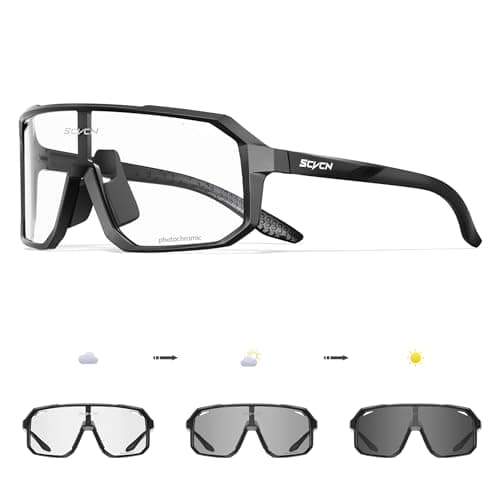
| SCVCN 501 Photochromic Cycling Glasses — Best cheap spare pair | Anyone who wants a photochromic backup in the transition bag or a pair they will not mourn. | $15.99 | View |
The picks, in detail
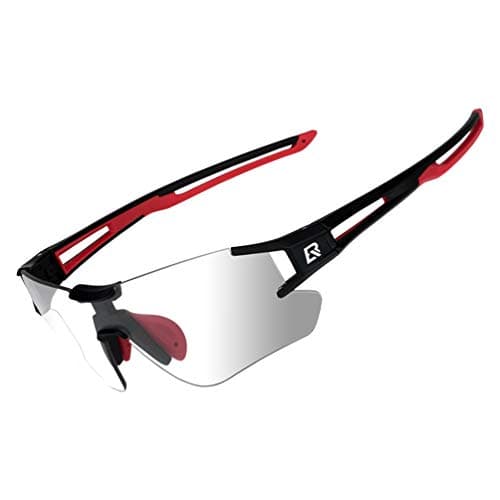 #1
#1ROCKBROS 22g Photochromic Sports Sunglasses — Best overall for changing light
Best for: The age-grouper who wants one pair that works from a grey 7am bike start to a sun-baked midday run.
- Photochromic lens darkens as the day brightens, so you are not squinting at noon or riding blind in dawn shade
- Listed at 22g, light enough that you forget it is there on a long run
- Semi-rimless shield leaves the top of the lens open, which helps clear fog once you are moving
- Thin straight arms slide under most helmet straps and retention systems without pressure points
- Cheap enough to own two and keep one in the race bag
- Photochromic transition takes time — it will not keep up with a fast tunnel-to-sun or dense tree cover
- Clarity and edge distortion are not on the level of premium optics; you notice it most in flat light
- Anti-fog coating wears off with repeated wiping, and wiping a wet lens with a tri suit is how you scratch it
- Fit runs narrow-to-medium; wide faces may get temple pressure under a helmet
This is the default answer for triathlon eyewear at this price: a photochromic lens solves the single biggest problem in the sport, which is that your race spans two completely different light conditions. Based on spec comparison and how widely these show up in age-group racks, the combination of low weight, open-top frame and a self-adjusting tint covers more race scenarios than any fixed-tint pair here. Skip it if you race exclusively in bright, stable desert-style sun — a proper polarized lens will look better.
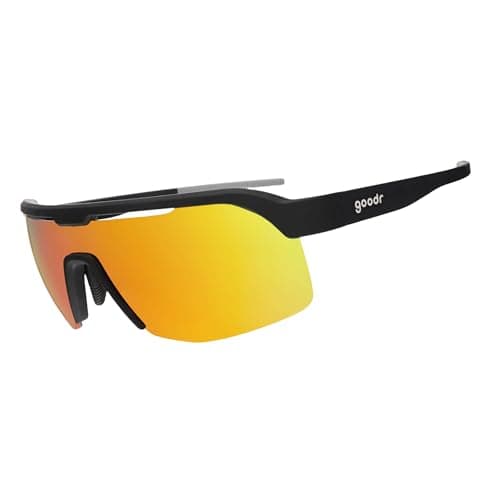 #2
#2goodr Bolt G — Best for the run and all-day comfort
Best for: Runners and long-course athletes who hate glasses bouncing or slipping once the sweat starts.
- goodr's grip coating is genuinely good in sweat — these stay put on a hot Ironman marathon
- Sport-shield shape gives decent wind coverage without a heavy frame
- Polarized lens cuts glare on open roads and water-adjacent run courses
- Flexible frame survives being crammed in a transition bag
- Widely available and consistently sized, so you know what you are getting
- Fixed tint — no help at a pre-dawn start or on a heavily shaded run course
- Polarization can dim or shimmer some bike computer and phone screens depending on head angle
- Closer fit means it fogs faster than an open-top cycling shield if you stop moving
- Costs more than the photochromics here without better optical clarity
goodr built its reputation on the no-slip coating, and that is exactly the failure mode most triathletes hit: glasses walking down your nose at mile 8. As a run-first pick it is excellent, and the Bolt G shape has enough lens to work on the bike in bright conditions. If most of your racing starts in darkness or under trees, take the photochromic at number one instead and save these for training in summer.
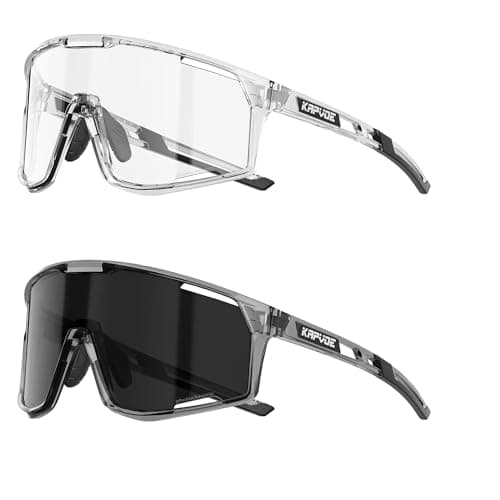 #3
#3KAPVOE K180 Photochromic Cycling Glasses — Best coverage in an aero position
Best for: Riders who spend real time in the aero bars and want wind, dust, and road spray off their eyeballs.
- Large one-piece shield covers the gap that opens up when your head drops into aero
- Photochromic lens goes from near-clear to tinted, so early starts and bright finishes are both handled
- Wraparound coverage keeps wind out of the eyes at speed, which reduces watering and blinking
- Frameless top edge vents air across the lens to fight post-swim fog
- Big shield looks and feels bulky on the run for smaller faces
- Stock is intermittent, and colorways come and go
- More lens area means more surface to fog if you are stopped or climbing slowly in humidity
- No-name optics: expect a bit of peripheral distortion compared with premium brands
Coverage is the underrated spec for triathlon because your head angle on a tri bike puts your eyes near the top edge of a normal lens. A tall shield like this fixes that, and pairing it with a visorless aero helmet is a proven setup. Buy it if the bike is your priority leg; if you want one pair that disappears on the run, go smaller.
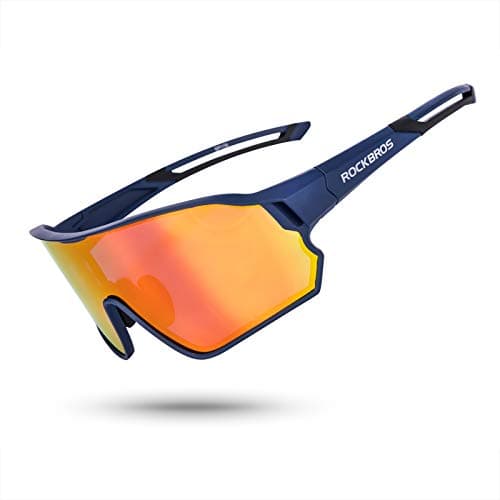 #4
#4ROCKBROS Polarized Sports Sunglasses — Best for bright, glare-heavy races
Best for: Athletes racing midday in full sun, on open highways or coastal courses with heavy reflected glare.
- Polarized lens genuinely reduces glare off wet pavement, car hoods, and water
- Cycling-specific wrap shape with rubberized nose pad that holds when wet
- Slim arms play nicely with helmet straps
- Priced low enough to be a dedicated bright-day pair
- Polarization can make some bike computer and watch screens hard to read at certain angles
- Fixed dark tint is a liability on shaded run courses and dawn starts
- Less venting than the semi-rimless options, so it fogs more readily in T1
- Build quality is fine, not durable-forever — hinges are the weak point
Polarized and photochromic solve different problems, and glare is the one polarization actually fixes. If your races are hot, bright, and on open roads, this is the more comfortable lens — just be aware of the screen issue and check it against your own head unit before race day, not on race morning. Not the pick if you own one pair and race in variable conditions.
 #5
#5SCVCN 501 Photochromic Cycling Glasses — Best cheap spare pair
Best for: Anyone who wants a photochromic backup in the transition bag or a pair they will not mourn.
- Photochromic lens at the lowest price in this pool — near-clear early, tinted later
- Wraparound shield gives decent wind coverage for the money
- Light enough for the run leg
- Ideal as a training pair or a second set for travel races
- Optical quality and coating durability are the obvious compromise; scratches show up fast
- Photochromic range is narrower than better lenses — it never gets truly dark
- Fit is generic and can slide on narrow faces once wet
- Listing variations and naming are inconsistent, so hinges and finish can vary
Every triathlete eventually sits on a pair of sunglasses or loses them in a transition bag, which is why a throwaway photochromic has a real place. Treat this as the pair that lives in your transition bag permanently so you are never caught without eyewear. Do not make it your only pair if you ride fast descents — you want better clarity at speed.
What to look for
- Photochromic over fixed tint for most races — early starts and long days mean the light changes dramatically. A lens that adapts beats one that is perfect for two hours and wrong for the rest.
- Open-top or semi-rimless frames for fog — after the swim your face is wet and your breathing is heavy. Airflow across the lens clears fog; a sealed, close-fitting frame traps it no matter what coating is advertised.
- Thin, straight temple arms — they need to slide under a helmet's retention cradle and straps without creating pressure points. Thick or heavily curved arms fight your helmet, especially aero lids.
- Rubberized nose and temple grip — the only thing standing between you and glasses on your chin at mile 10 of the run.
- Enough lens height for aero — in the bars, your eyeline rises toward the top of the lens. Small lifestyle-shaped frames leave you looking over the top into the wind.
- Polarized with caution — great for glare off water and pavement, occasionally annoying on LCD bike computers and watch screens. Test with your own bike computer before race day.
Common questions
How do I stop my glasses fogging in T1?
Do not put them on until you are moving. The standard move is to leave them open on your bars or in your helmet, mount, get up to speed, then put them on — airflow keeps the lens clear. Also avoid drying your face with a towel and then pressing a warm lens against wet skin. If you are a chronic fogger, choose a semi-rimless frame with an open top edge.
Should I wear glasses inside an aero helmet with a visor?
No — pick one. Stacking sunglasses behind a visor doubles your fogging risk and usually creates a gap that whistles in the wind. If your helmet has a visor, race without glasses on the bike and keep a pair in T2 for the run.
Are cheap sunglasses actually safe for cycling?
UV400 protection is cheap to manufacture and standard on everything here, so eye protection is not the concern. The difference you pay for with premium brands is optical clarity, impact-rated lenses, coating durability, and replaceable parts. For racing, coverage and fit matter more than the badge.
Polarized or photochromic if I can only have one?
Photochromic, for triathlon specifically. Race morning light and midday sun are too far apart for a single fixed tint, and glare is a smaller problem than not being able to see.
Also worth a look, though none were in this round's pool: Oakley Radar EV Path and Sutro for the best-in-class clarity and lens options, Roka Matador for a tri-specific fit that holds in sweat, Tifosi Rail for interchangeable lenses at a mid price, and Smith Attack MAG for fast lens swaps between race and training tints.
Bottom line
One pair for everything: the ROCKBROS 22g Photochromic. Run-focused comfort and grip in the heat: goodr Bolt G. Maximum coverage for time in the aero bars: KAPVOE K180. Bright, glare-heavy courses where you want polarization: ROCKBROS Polarized. A spare that lives in the race bag forever: SCVCN 501. And if you are still building out the rest of your kit, start with the beginner gear checklist before you spend big on eyewear.
Written by
FullKitTri Editors
The FullKitTri editorial team reviews triathlon gear across every discipline and budget. Our recommendations are based on hands-on racing experience, independent research, and hundreds of hours comparing products.
- Combined 50+ triathlons completed
- Sprint through Ironman distance experience
More in Training & Race Day
Best Race Belts and Elastic Laces for Fast Triathlon Transitions in 2026
Race belts and elastic laces are the cheapest speed you can buy. Our ranked picks for gel loops, lace tension, and sockless running in T1 and T2.
Read guideBest Triathlon Transition Bags and Backpacks in 2026
Six triathlon transition bags and backpacks compared on wet/dry separation, helmet protection, capacity for sprint to Ironman, and carry-on travel.
Read guideTriathlon Transition Tips: How to Nail T1 and T2
Step-by-step T1 and T2 technique for triathlon — flying mounts, sockless running, helmet rules, and the drills that shave 60+ seconds without any fitness gain.
Read guideBeginner Triathlon Gear Checklist: Everything You Need for Your First Race
A complete triathlon gear checklist for first-time racers — what you actually need for the swim, bike, and run, what you can skip, and what to spend money on.
Read guide#1 pick
ROCKBROS 22g Photochromic Sports Sunglasses — Best overall for changing light